In 1995, I lived in Prague, and spent much time watching rugby and drinking beer. Our club, the Prague Barbarians, had gathered in an Irish pub to watch the Rugby World Cup final featuring the mighty All Blacks and the surprise package of the tournament, the hosts, South Africa.
Jonah Lomu had literally run over Scotland and England on the way to the final, and New Zealand were fancied to win.
As a part of the world’s disapproval of apartheid, South Africa had been excluded from the Olympics since the 1960s. Rugby participation had continued, but eventually that too came to an end, countries unprepared to exclude their own diverse squads of players to fit the apartheid laws. South Africa’s Springboks were barred from the first two World Cups in 1987 and 1991.
The Springboks were loathed by black South Africans. For many, the jersey represented white oppression. For Afrikaners, South Africans of mainly Dutch descent, rugby was integral to their cultural identity.
After his election in 1994, Nelson Mandela encouraged Black South Africans to get behind the Boks, and formed an unlikely alliance with South African rugby captain François Pienaar.
If you close your eyes, and imagine what an Afrikaner rugby player might look like, you will not be far from the Captain. Born to a working class family in Transvaal, Pienaar looked and sounded like a white South African from central casting. Blue-eyed, fair-haired and a rugged, angular face that could have been carved from stone.
The new President was presented to the teams on the pitch. He appeared in a South African jersey, the famous Springbok over his heart. It’s hard to think of a symbol more powerful to many Afrikaners. Cheers rang around the stadium, South Africa’s new flag prominent in the stands. As Mr Mandela greeted the players, we caught a glimpse of his back.
“He’s wearing Pienaar’s number!”
The great icon of black majority-rule South Africa was wearing the shirt of Afrikaner captain Pienaar. The chant went around the ground. “Nelson! Nelson!”
The game began and we awaited Lomu’s first run. Surely, he would bulldozer the South Africans as he had everyone else. Here he comes...
Nailed.
Joost van der Westhuiizen, South Africa’s scrum-half, had wrapped himself around Lomu’s legs, bringing him down. Not once, but several times. Try though he might, Lomu had no significant impact on the match.
A tense, close game unfolded. South African forward power matched against explosive back play from the All Blacks. Neither team scored a try, and the All Blacks hauled themselves back to parity at the end of full time. Extra time began at nine points each. New Zealand took the lead, until South Africa equalised with a penalty and finally edged ahead with a drop goal. The game finished with South Africa ahead 15 -12.
As he completed an emotional lap of honour, Pienaar was interviewed by a South African TV journalist.
“François, and then we had sixty-five thousand South Africans here today; tremendous support...”
“David, we didn’t have sixty thousand South Africans, we had forty-three million South Africans.”
There it is. A mic-drop moment.
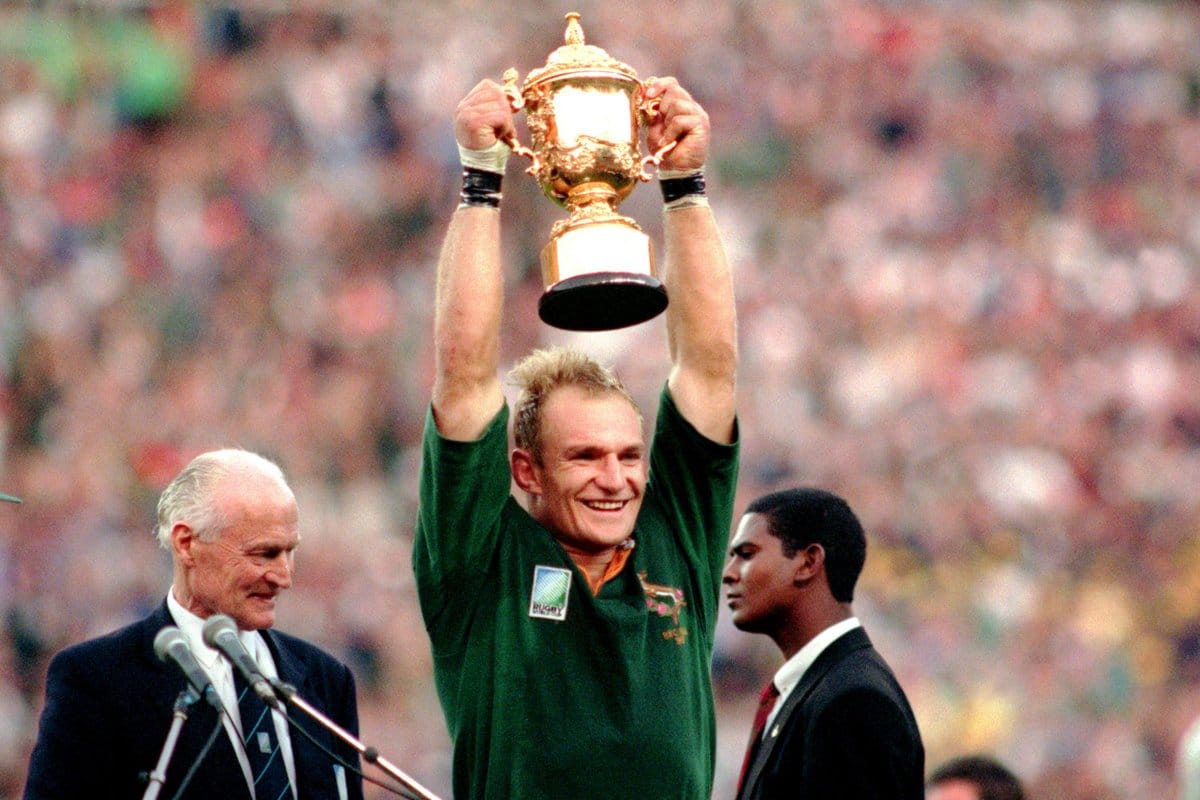
The President handed the trophy to the Captain who hoisted it above his head, and Mr Mandela stood beside him, both arms aloft in triumph. The two of them together, a picture of a new, inclusive South Africa.
“Invictus”, a movie directed by Clint Eastwood tells the story of the 1995 Rugby World Cup. “Playing the Enemy” a book by John Carlin explores the same event and is the basis of the movie.
There’s also a BBC Hardtalk interview with Pienaar, twenty years later, where he delivers another killer line or two, but you’ll have to watch for yourself. It makes me cry. Every. Single. Time.